


Young Talent for the Future of Manufacturing

When young talents from around the world compete at WorldSkills for the world championships in CNC turning and CNC milling, there’s more at stake than just medals, namely, a passion for manufacturing and the international future of technical trades. DMG MORI has been a Global Industry Partner of WorldSkills International since 2016 and supports the competitions with turning machines and universal machining centers, technical support, seasoned experts, and preparatory training. For example, in Shanghai, participants from Japan, Korea, Vietnam, and Singapore are being prepared for the competitions. In Geretsried and Stockerau, we welcomed several European teams, as well as teams from Brazil and Canada.
Jörg Harings, Head of Training, and Boris Satarov, Technical Trainer at the DMG MORI Academy and National Coach for CNC Turning, discuss the significance of WorldSkills for both participants and DMG MORI.
WorldSkills is often referred to as the “Olympics of the trades.” In your opinion, what makes this comparison apt? Or does it fall short?
Jörg Harings: The comparison is certainly valid. Just like in sports, the best in each discipline come together here to compete. This year in Shanghai, more than 1,500 young people from over 70 nations and 64 professions will compete against one another. Of course, they all dream of a spot on the podium. But just like at the Olympics, certain disciplines take center stage here that would otherwise not be in the spotlight of the general public.
Boris Satarov: In this way, WorldSkills not only draws attention to trades that depend on the next generation of workers; it also generates enthusiasm because every participant competes with great passion.
You have been a Global Industry Partner for ten years. What is it that has kept DMG MORI so closely connected to WorldSkills?
Jörg Harings: Our collaboration dates back nearly 20 years. Even back then, we supported the competitions with machine tools. So you could say this is an international partnership that has grown over many years. Continuity plays a major role in this context because, at its core, it’s about fostering the next generation of talent. This is a very long-term endeavor. DMG MORI combines social responsibility with a long-term vision for the future of manufacturing and machine tool engineering.
Does that mean DMG MORI has taken on more and more responsibility in this partnership?
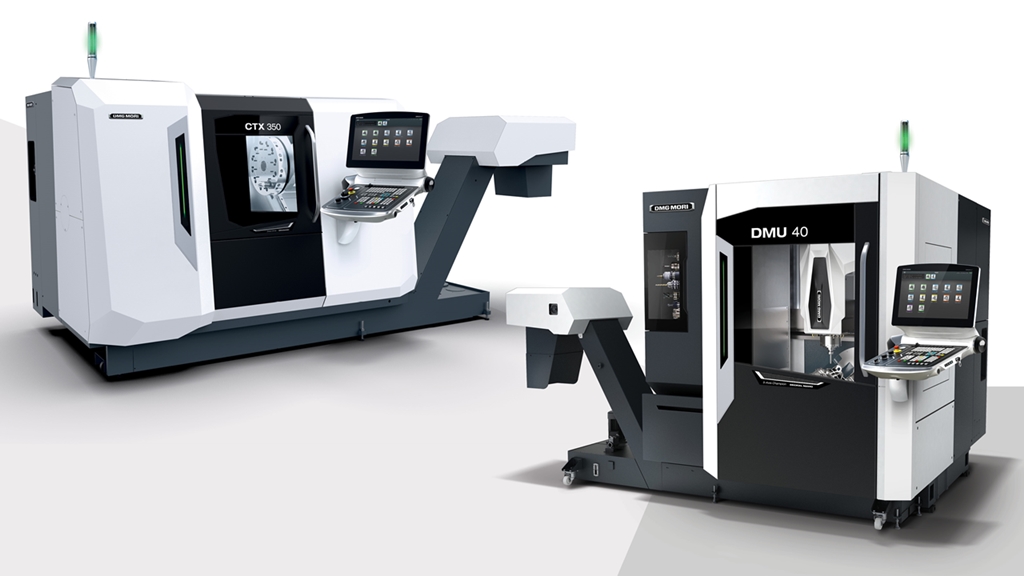
Boris Satarov: That’s right. Our role has evolved. We’ve long since moved beyond simply providing modern CNC technology. We prepare young talents for WorldSkills using the CTX 350 V4 and DMU 40 Plus competition machines. In CNC turning, we train eleven of the 23 participating nations; in CNC milling, ten of the 27. We manage this logistical challenge with three training locations.
Jörg Harings: Digital Transformation (DX) is also a topic covered in the training sessions. In collaboration with Siemens, we are introducing a digital twin for the first time: “Run my Virtual Machine.” As a module for workpiece optimization, it is an integral part of the competition.
The preparation and the competition bring together teams from a wide variety of countries and educational systems. How do both the participants and DMG MORI experience this international exchange?
Boris Satarov: The training sessions are conducted in small groups or one-on-one. The actual exchange, both cultural and professional, takes place primarily during the competitions. With so many nations participating, very different approaches to work sometimes come together. Everyone involved can benefit from this.
Jörg Harings: From DMG MORI’s perspective, our international approach is an integral part of our DNA. We operate globally while maintaining a local presence close to our customers. That makes it all the more rewarding when we can bring so many nations together in one place.
To what extent does the competition address the challenges facing the industry?
Jörg Harings: Creating a workpiece with a competitive spirit may not be all that different from real-world manufacturing. In practice, rising quality standards in industry and intense delivery pressures require a similar mindset and, above all, the same motivation. A high degree of precision and efficient processes result in competitive production. Experience shows that the young competitors, even outside of WorldSkills, go on to work for companies that share exactly this philosophy.
Boris Satarov: During the training sessions, participants are also introduced to state-of-the-art machine tool technology and the CELOS-based control system, should they not already be familiar with these from their training. They learn about the capabilities of the CTX 350 V4 for turn & mill, as well as the possibilities of 5-axis machining on the DMU 40 Plus. WorldSkills thus consistently demonstrates what modern manufacturing looks like.
This means that WorldSkills also holds strategic importance for DMG MORI. How important is supporting the next generation to the long-term competitiveness of DMG MORI and its customers?
Jörg Harings: Despite all the technological advancements DMG MORI is driving forward, people remain a key competitive factor. We and our customers rely on qualified personnel who recognize and harness the potential of ongoing process integration, automation, and digitization. Our Machining Transformation (MX) paves the way for the future of manufacturing. This also involves nurturing young talent today so that the industry will have the skilled workers it needs tomorrow.